

Clear Paths to Graduation
Academic maps and milestones translate complex degree requirements into practical registration plans showing exactly what courses to take each semester to graduate in two or four years, addressing challenges of undecided students, major changes, and complex requirements while ensuring early exposure to major coursework.
Complex Requirements
Most catalogs are difficult to understand with unclear degree requirements
Excess Credits
Students graduate with significantly more credits than required, costing thousands
Poor Sequencing
Students take courses in wrong order or that don’t count toward graduation

Proof Points
Academic maps and milestones provide clarity and structure in confusing academic environments while ensuring proper course sequencing that supports academic performance and completion.
- Students following academic maps complete degrees with fewer excess credits, reducing time by average of one semester
- Clear pathways demonstrate better academic performance and higher retention rates
- Students avoid average of $38,000 in excess credit costs and up to $147,000 in lifetime earnings loss
- Improved resource planning allows optimal classroom scheduling and course capacity management
The College of Southern Nevada developed visual academic maps integrated with advising systems and student success tracking, incorporating both academic and career pathway information. This enhanced student retention and completion rates through structured academic planning.

College of Southern Nevada
Las Vegas, NV
Benefits
Academic maps and milestones eliminate confusion and wasted credits while providing institutions with better resource planning capabilities and students with clear, achievable pathways to graduation.
Faster Completion
Reduced time to graduation through efficient course sequencing and planning
Cost Savings
Elimination of unnecessary courses reduces student debt and financial burden
Better Planning
Clear roadmaps enable better academic and career decision-making
Related News
-
 Learn More: Amplification Lab: ASAP|ACE Momentum on Display at the SUNY Student Success Summit
Amplification Lab: ASAP|ACE Momentum on Display at the SUNY Student Success Summit
The SUNY Student Success Summit showcased how the university system is scaling the proven ASAP|ACE completion model across 34 campuses, with plans to serve 10,000 students by Fall 2026 through a $12 million state investment. This collaborative gathering demonstrated the power of communities of practice in driving system-wide transformation that maintains program fidelity while adapting…
-
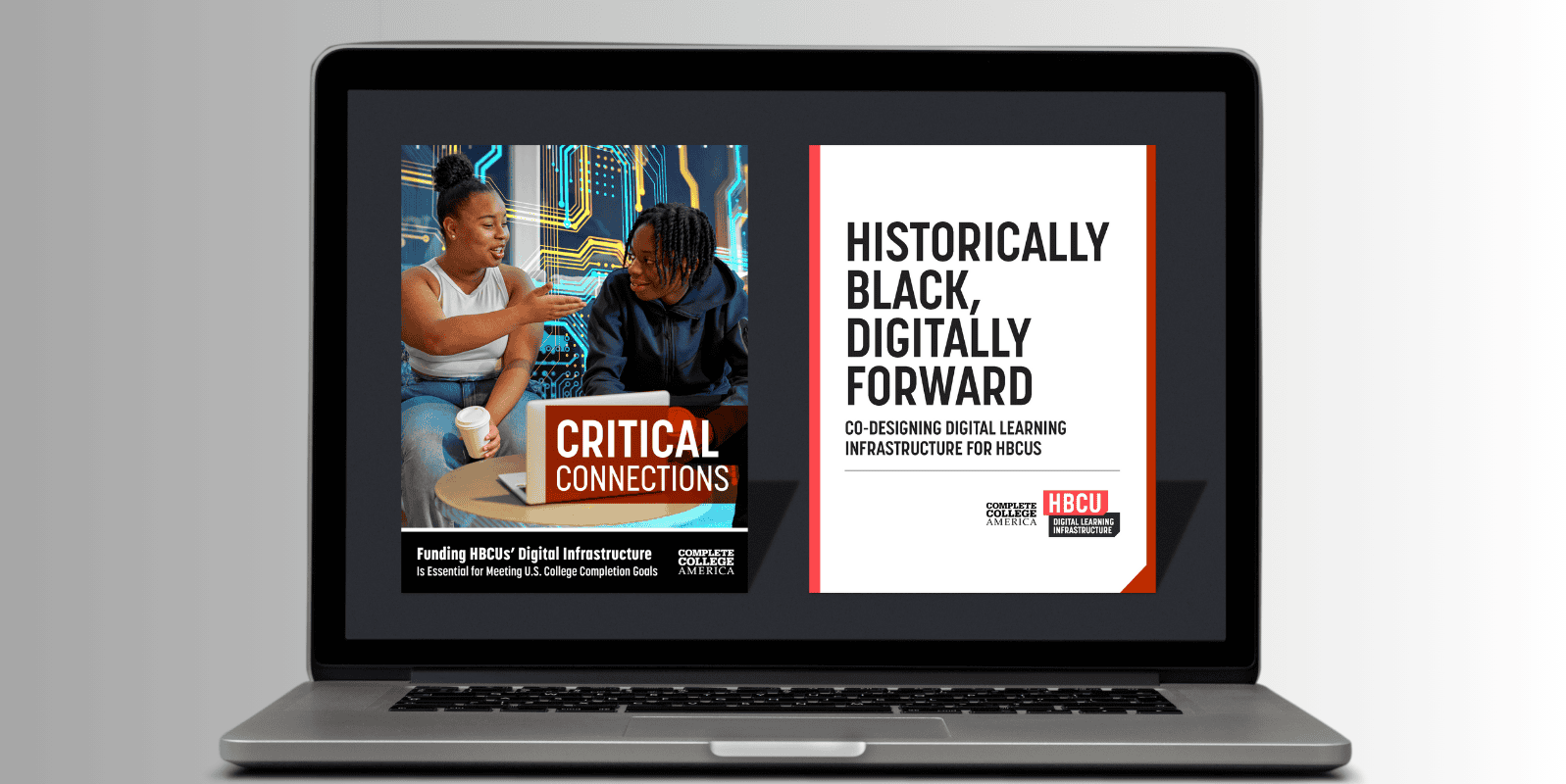 Learn More: New Report Calls for Investment in Technology Infrastructure at Historically Black Colleges to Boost Completion Rates
New Report Calls for Investment in Technology Infrastructure at Historically Black Colleges to Boost Completion Rates
Complete College America releases new research highlighting need for digital transformation efforts at HBCUs, calls for increased investment in technology upgrades and physical infrastructure to boost student success
-
 Learn More: Celebrating 10 Years of Houston GPS
Celebrating 10 Years of Houston GPS
It’s been 10 years since Houston Guided Pathways to Success (GPS) launched, and CCA is proud to be part of this decade-long effort to increase the number of bachelor’s degrees in Houston. It’s a long-term economic win for the community and a model for cross-institutional partnerships. Read more about the launch, implementation, and successes of…
Related Resources
-
Learn More: The College Student Success Game
The College Student Success Game
Back to CCA Games Videos, Resources, and Downloads Take on the role of a student and try to move toward earning a postsecondary credential. How far can you advance in four semesters? Can you find the academic support you need to pass all of your classes? This game is best played with four to six…
-
Learn More: Games for College Completion
Games for College Completion
Step into the shoes of a student entering college. What obstacles will you encounter? What supports might help you? Complete College America’s games provide college leadership, faculty, staff, higher education researchers, and non-profit organizations the opportunity to experience the journey toward college completion through a first-person, immersive experience. The games recreate the challenges, resources, and…
-
Learn More: CCA Acclerator Webinar – Pathways with Marion Technical College and The Ohio Association of Community Colleges
CCA Acclerator Webinar – Pathways with Marion Technical College and The Ohio Association of Community Colleges
Pathways to Success: Supporting Students from Entry to Employment CCA Alliance Engagement Director Jennifer Torres welcomes Dr. Bob Haas, Provost and Chief Strategy Officer at Marion Technical College, and Laura Rittner, a CCA Fellow and Vice President of Operations and Student Success at the Ohio Association of Community Colleges (OACC). Our guests share their strategies…
Explore Our Work
We are shifting policy at the state and federal level, changing perspectives among educators and administrators, and implementing proven strategies across hundreds of campuses.