Playbook from Complete College America and the Campaign for College Opportunity provides policy recommendations to help California add 1.3 million more adults with credentials of value—and strengthen the Golden State’s economy
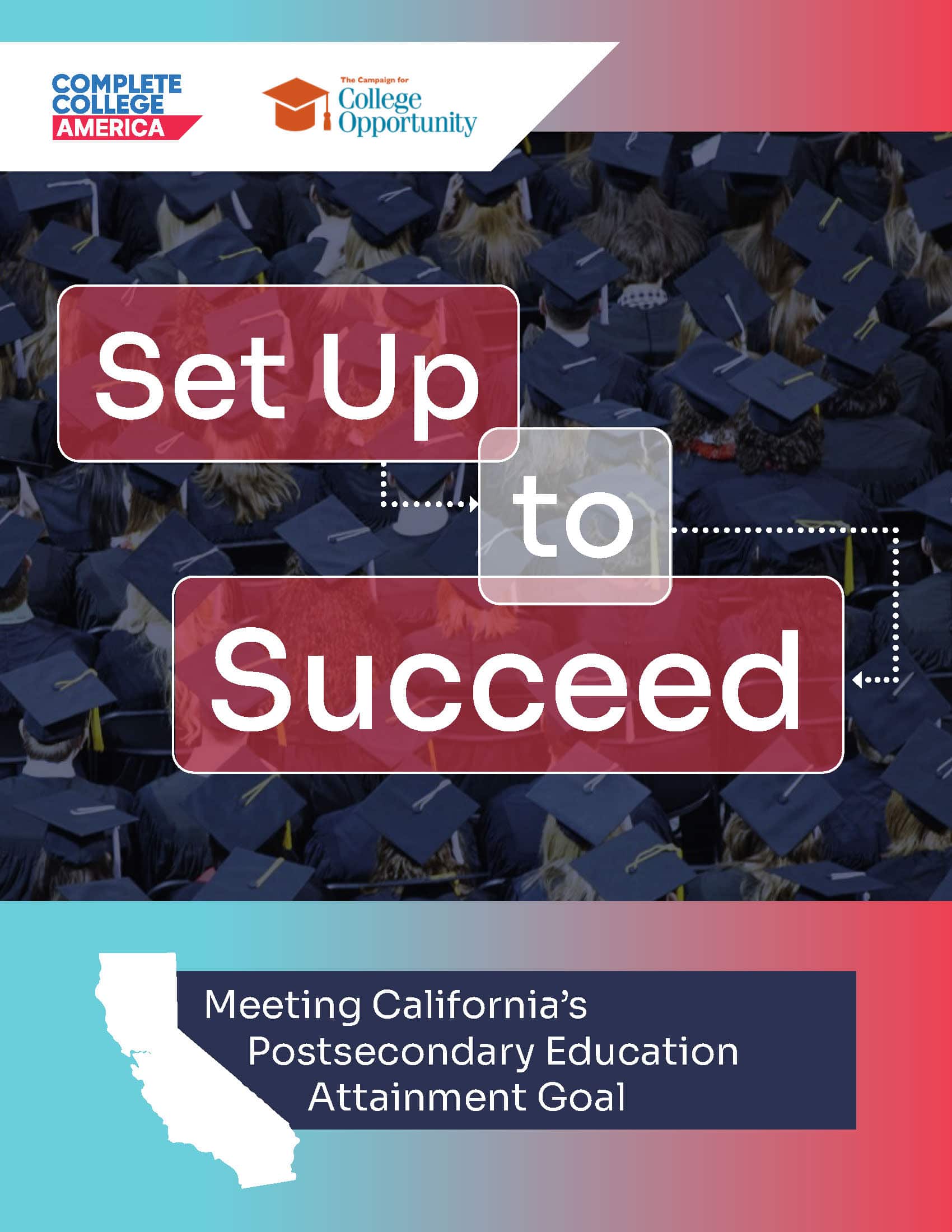
CALIFORNIA (March 3, 2026) — Complete College America (CCA) and The Campaign for College Opportunity today released a new statewide playbook outlining the policy and system-level reforms California must implement to meet Governor Gavin Newsom’s goal of 70 percent postsecondary attainment by 2030. Entitled Set Up to Succeed: Meeting California’s Postsecondary Education Attainment Goal, the report provides an overview of the current college completion landscape in California—and offers a clear set of strategies to help the state close attainment gaps, increase college completion and ensure Californians have access to credentials and degrees that lead to economic mobility.
“At a moment when California’s economy is the fourth largest in the world, we have both the responsibility and the opportunity to ensure that higher education works for everyone—not just those who already know how to navigate it,” said Jessie Ryan, president of The Campaign for College Opportunity. “While our state has made meaningful progress, too many of our systems still operate in isolation, forcing students to untangle fragmented pathways on their own. California can and must do better. This report lays out a bold, student-centered roadmap to modernize our higher education system, close persistent equity gaps, and ensure that every Californian has a clear, supported path to the degrees and credentials that unlock lifelong opportunity.”
Even as California has made progress in expanding postsecondary access, the state remains far from its 70 percent attainment goal by 2030—with more than 5.9 million Californians under 65 holding some college credit but no credential, completion rates across public systems largely flat, and persistent gaps in gateway math and English.
According to the report, California’s statewide attainment rate stood at 56 percent in 2023, leaving the state needing to produce 1,307,047 additional educated adults in the next five years to meet its 2030 goal. Reaching that target will require not only increasing enrollment across the state’s public higher education systems but also significantly improving completion outcomes.
The report also makes clear that California’s attainment goal is not simply a higher education benchmark, but a workforce and economic imperative. Labor market projections indicate that more than two-thirds of annual job openings in California between 2021 and 2031 will require some form of postsecondary education or training, with the strongest growth in high-demand sectors like healthcare and STEM.
“California has set an important and necessary goal for postsecondary attainment—but reaching it will require urgent action and sustained investment,” said Dr. Yolanda Watson Spiva, president of Complete College America. “This playbook provides a clear roadmap for how California can align policy, practice and funding around proven strategies that work. The question is not whether California can reach 70 percent attainment, but how to ensure that state and system leaders can rapidly and effectively scale these reforms to remove barriers and set every student up to succeed, regardless of zip code or background.”
To address these challenges, the report outlines a comprehensive set of strategies aligned with CCA’s nationally recognized Core Strategies as well as the University of California (UC) and California State University (CSU) compacts and the California Community Colleges roadmap. Among the key strategies are:
- Strengthening coordination between the UC, CSU, and California Community College systems and overhauling the state’s outdated higher education master plan;
- Expanding dual enrollment and early college access opportunities;
- Continuing the state’s momentum on reforming developmental education to ensure every student in their first-year can succeed in credit-bearing coursework;
- Improving transfer systems through common course numbering and clearer articulation agreements;
- Expanding credit for prior learning to accelerate adult learner completion;
- Investing in proactive advising, 360-degree coaching, and student basic needs support;
- Creating stackable credentials and structured academic maps to reduce excess credits and time-to-degree;
- Implementing a statewide metrics framework through the Cradle-to-Career Data System.
The report also calls for a renewed focus on funding structures that support transformational reform at scale, including a potential shift toward “completion-goals funding”—a model designed to provide institutions with upfront resources tied to clear attainment targets.
The playbook emphasizes that meeting the 70 percent goal will require coordinated action across TK–12, community colleges, four-year universities, workforce systems, and state government, including implementation of new structures such as the California Education Interagency Council, established through A.B. 1098 and S.B. 638.
To read the full report, visit: completecollege.org/set-up-to-succeed.
For more information or to schedule an interview, contact: media@completecollege.org
###
About Complete College America: Complete College America (CCA) is a bold national advocate for dramatically increasing college completion rates and closing institutional performance gaps by working with states, systems, institutions, and partners to scale highly effective structural reforms and promote policies that improve student success. To learn more about CCA, visit www.completecollege.org
About the Campaign for College Opportunity: The Campaign for College Opportunity is a California bipartisan policy and research non-profit organization focused on a single mission: to ensure all Californians have an equal opportunity to attend and succeed in college in order to build a vibrant workforce, economy and democracy. For more information, visit www.CollegeCampaign.org / Facebook.com/CollegeCampaign or follow @CollegeOpp.