By Jamia Stokes, Alliance Engagement Director
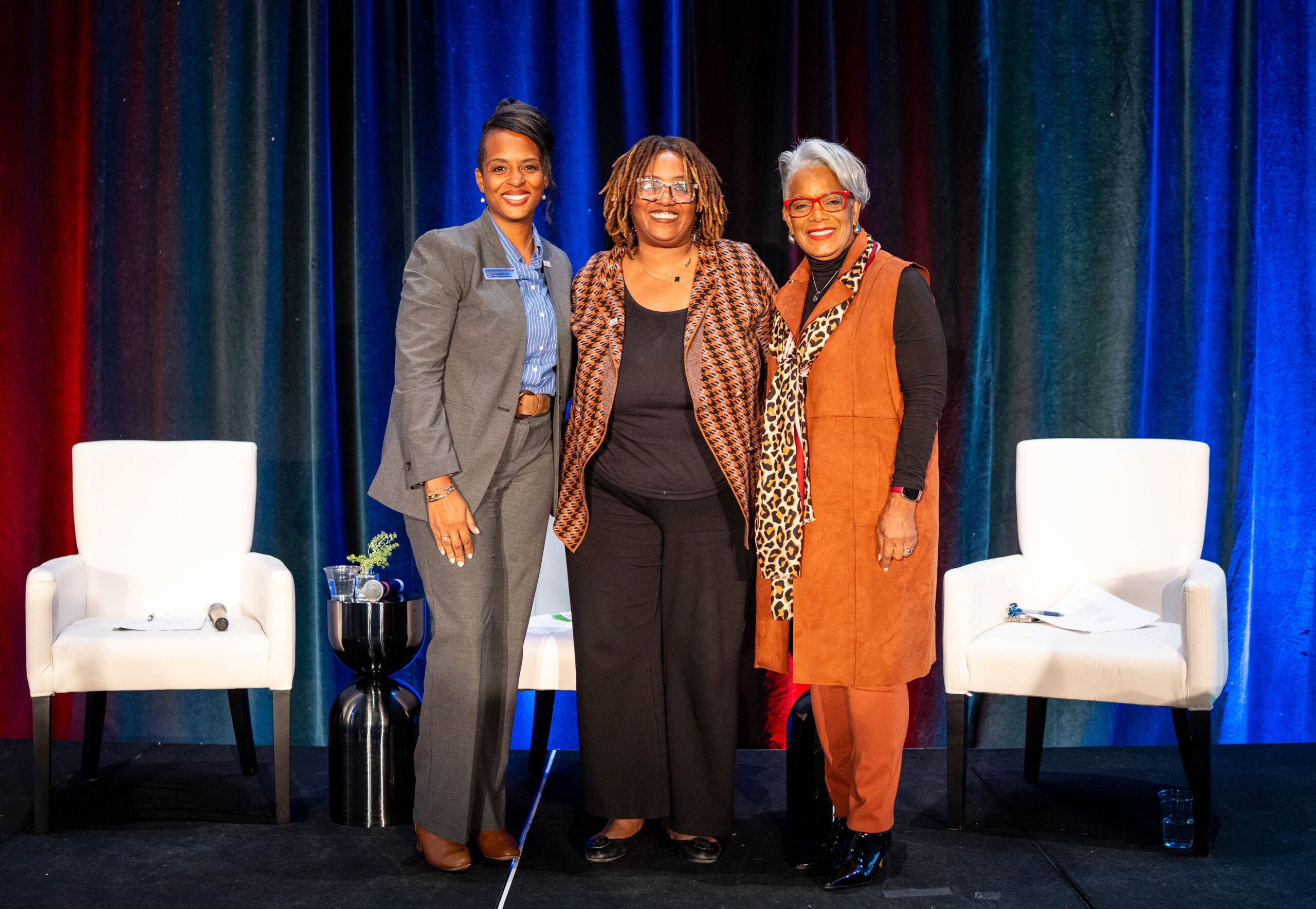
At a moment when higher education faces unprecedented scrutiny, what does courageous leadership actually require? This was the central question that guided our conversation at Complete College America’s Annual Convening in Baltimore, recorded as part of the Higher Endeavor Network’s Equity and Racial Justice Learning Track.
I had the privilege of moderating a discussion with two remarkable leaders: Dr. Kijua Sanders-McMurtry, CCA Fellow and Vice President for Equity and Inclusion at Mount Holyoke College, and Dr. Margaret Montgomery-Richard, CCA Fellow and Retired Chancellor, Louisiana Technical College. Together, we explored how today’s higher education leaders can both defend education’s essential promise and honestly reckon with its limitations.
The Moment We’re In: Different This Time
Dr. Montgomery-Richard framed the current challenge starkly: “Historically we had some cover or buffers from the Department of Education or the EEOC, but now we don’t have support at the government level.” The institutional scaffolding that once provided protection for equity work has been dismantled. Education has long been sacred ground in American society, but the stakes feel profoundly different for many in the field.
Yet both panelists were unwavering about why they continue to do this work.
“I know the work is right and good,” Dr. Montgomery-Richard said. “Education is the way to move people to higher socioeconomic mobility. We all deserve access and opportunity. I am here because someone opened doors for me and I want to do the same for others.”
Dr. Sanders-McMurtry built on this foundation with a compelling reminder: “Democracy cannot exist without an educated population.” She continued, “We know the power of transformation that education provides. In this moment, our North Star is access, equity, and inclusion. We can’t give up or be daunted by the current administration’s policies. We must keep moving forward and believe that we are on the right side of history.”
The reason is simple but profound: People are in higher education institutions because they want to have a better life.
Standing Firm: Mission as Anchor
When I asked about navigating the tension between what’s politically expedient and what one considers the best approach—particularly as DEI initiatives face organized opposition—both panelists emphasized the importance of being anchored in institutional mission.
“We need to be anchored in something,” Dr. Montgomery-Richard stressed. “Our mission should lead us in the work. We need to encourage leaders to stand firm on their mission.”
She offered community and technical colleges as a powerful example: “Workforce has always been at the core of the mission of community and technical colleges. All parents sending their children to college expect their children to graduate with the education and skills necessary to earn a living wage. We now need to apply this same thinking to universities. She emphasized that “The time is now.”
Coalition-Building: Learning from the Civil Rights Movement
One of the most moving moments came when Dr. Sanders-McMurtry shared insights from teaching a first-year seminar on Women in the Civil Rights Movement. Through documentaries like Freedom Summer and Eyes on the Prize, her students witness how diverse organizations worked together—intergenerationally and interracially—as a coalition to advance civil rights.
“People need to understand how people work together now more than ever,” she reflected. “Americans needed access to resources including the right to vote to live in our democracy more fully. We are still in this fight 50 years later because we understand the importance of everyone having access to education. We have an opportunity to build on the legacies of the people who came before us.”
Dr. Montgomery-Richard commented on this historical parallel with a powerful framing: “This is our civil rights movement.” She traced the through-line: “We had the first reconstruction after the civil war. The second happened during the civil rights movement. And we are currently in the third iteration. We need to be the change we want to see in the world.”
Reckoning with Our Limitations
The conversation didn’t shy away from higher education’s shortcomings. We discussed the current wave of antisemitism on campuses, which Dr. Sanders-McMurtry noted “forces us to think about the things that we are not doing well. We need to think about how we attend to those things. We need to think about how to help students build solidarity with one another.”
This honest reckoning—acknowledging where institutions have failed even as we defend their essential promise—is what gives our advocacy credibility.
What Courageous Leadership Requires
As we closed, both panelists offered final reflections on what courageous leadership demands in this moment.
Dr. Montgomery-Richard emphasized personal discernment: “You as an individual need to think about your own risk tolerance. At different stages of your career, you can make different decisions. As you get deeper in your work, you may have more tolerance. Only you can decide what your risk tolerance is.”
Dr. Sanders-McMurtry added a crucial dimension: “Courageous leadership requires humility.” She noted that some people struggle when ego becomes loud and insecurities surface. But the work itself provides clarity: “We believe that students should have the ability to complete college. This work is valuable and important. I want to stand firm on college completion for all students.”
Dr. Sanders-McMurtry also reminded us of an essential practice: “We need to continue to build ourselves up.” In a moment of sustained attack, self-care and community care aren’t optional—they’re strategic necessities.
What I’m Carrying Forward
Several insights from this conversation continue to resonate:
- We’re in the third reconstruction. Understanding this moment historically helps us see both the enormity of the challenge and the power of the legacy we’re building on.
- Mission is our anchor. When external support structures disappear, institutional mission becomes the through-line that keeps us focused and grounded.
- Risk tolerance is personal—and changes over time. Leaders must make honest assessments about what they can sustain, recognizing that courage looks different at different career stages.
- Humility is essential to courage. The most effective leadership happens when ego quiets, and the focus shifts entirely to students and their success.
- Democracy depends on educated citizens. This isn’t hyperbole—it’s the fundamental justification for continuing to fight for access, equity, and inclusion.
Most of all, I’m carrying forward the conviction that we are on the right side of history, even when the path forward feels uncertain. People come to higher education because they want better lives. Our job is to ensure that promise is real for everyone, not just for some.
Watch the Full Conversation

This blog post captures key moments, but the depth of wisdom and the energy in the room can only be fully appreciated by watching the full session. I’m grateful to Dr. Sanders-McMurtry and Dr. Montgomery-Richard for their candor, wisdom, and unwavering commitment to students.
This session was part of the Higher Endeavor Network’s Equity & Racial Justice Learning Track at Complete College America’s Annual Convening in Baltimore. Learn more about our work at completecollege.org.
— Jamia Stokes, Alliance Engagement Director for the Southeast Region, Complete College America