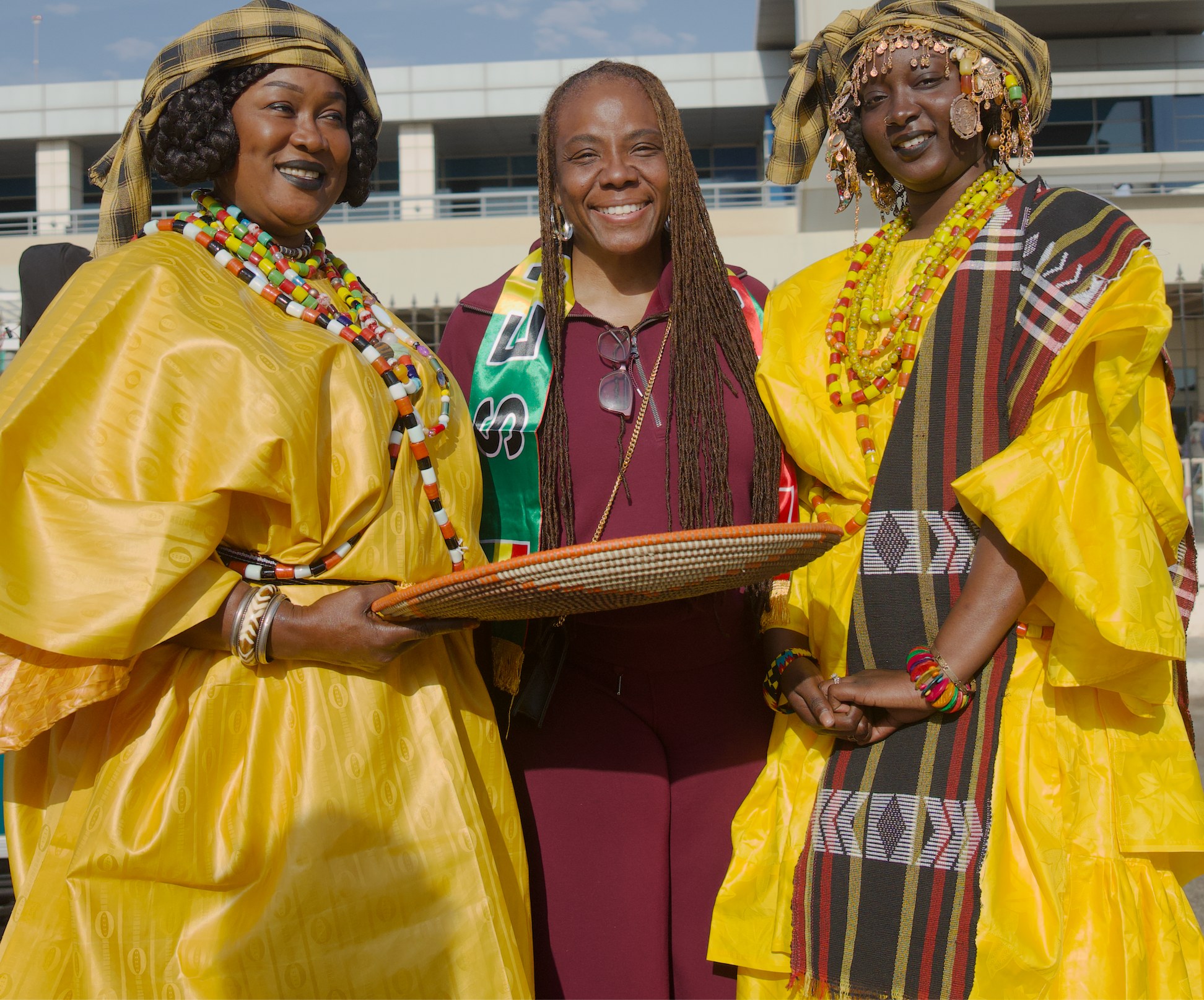
This spring, CCA President Dr. Yolanda Watson Spiva traveled to Senegal and The Gambia as part of the Building Bridges delegation, an effort to open study-abroad, cultural-exchange and entrepreneurial pathways for students at historically Black colleges and universities. Education leaders from five nations and 35 universities joined the conversations. We sat down with Dr. Watson Spiva to hear what she shared, what she learned, and why CCA’s work matters on the world stage.
Answers have been edited for length and clarity.
How did CCA get involved with the Building Bridges delegation, and why did it make sense for us to be in the room?
Students from underserved and under-resourced populations rarely get the chance to travel abroad or experience the educational and experiential learning other nations offer. I was contacted by Ambassador Waleed, who asked whether CCA, given our connections with the many institutions we serve, would help get a million students from HBCUs to experience travel abroad. Not just for the travel, but to study abroad, take part in cultural exchange, learn about their African ancestry and, for those interested in entrepreneurship, build connections across the African diaspora.
It was an ambitious goal, but it aligned with CCA’s goal of making sure our students and institutions don’t just have domestic reach, but global reach. Global cooperation and global competitiveness both happen at scale, and we wanted CCA in the conversation about how students make those connections, especially students from mission-focused institutions like HBCUs.
What did CCA share with the delegation, and how did people respond?
First, we shared how CCA partners with institutions on their institutional transformation efforts, and how we use state and federal policy in the United States to undergird that work.
The interest was tremendous. Even though we traveled to Senegal and The Gambia, representatives from five nations and 35 universities came to meet with us, so our reach was broader than the two countries we stepped foot in. Their college participation and completion rates are both low, so they wanted to know how we increase completion and get more students interested in college. They were especially interested in CCA’s four pillars of purpose, momentum, structure and support.
They also found our model unique: CCA isn’t a direct service provider to students. We work as an intermediary with the staff, administrators, faculty and systems that create and facilitate change for students. Many were interested in how they could partner with us to apply that approach in their own context.
There were conversations about rural campuses and the access issues students face. Did you see parallels with the United States?
Absolutely, especially with the rural colleges and universities in the CCA Alliance and the work we’ve done through our digital learning infrastructure projects. Many African institutions are brand new or still being built, yet their digital infrastructure is lacking. Many students don’t have their own laptops or tablets, and many don’t have phones. That is very similar to rural and impoverished communities in the U.S., where students lack the technology they need and communities lack the infrastructure to support it.
We met with the Ministers of Education for both Senegal and The Gambia, the equivalent of our Secretary of Education, so we had the ear of the highest levels of government. Both countries have a very strong government investment in education. Talking about how filling digital infrastructure gaps helps students succeed resonated with them, and they committed to applying more resources, whether fiscal, technological or through in-kind donations from technology partners. We also discussed with one of the ambassadors, whose family foundation is engaged in this work, how to get portable Wi-Fi to learners.
Those conversations were very reminiscent of the ones we’re having here about bandwidth and whether Wi-Fi should be considered a utility or a luxury good. I think most of us would say it’s now more of a utility.
Why does international work matter for an organization called Complete College America?
It’s easy to think our work should stay within U.S. borders. But part of making the case for a more educated citizenry is recognizing that America exports talent and know-how. Our knowledge economy is a big part of that. CCA partners on the global stage by sharing what we know about what makes higher education robust and effective.
We also forget how many students from abroad study in the United States because our higher education system is so strong. With students coming here and our students studying abroad, it’s imperative that we be at the table in global conversations about how higher education serves American students and those who come here for a postsecondary education.
Completion rates vary from country to country, but the problems are very similar.
Dr. Yolanda Watson Spiva, President, Complete College America
It’s been several months since the trip. Has it changed how you approach CCA’s mission or plans going forward?
We’ve invited a number of the leaders we met in Senegal and The Gambia to our Annual Convening, and the feedback about attending has been positive. Since then, I’ve also taken part in meetings at the United Nations in Geneva and New York, and last year I joined higher education leaders from around the world in Prague. The world is small. Completion rates vary from country to country, but the problems are very similar, and grappling with them in a global context opens up your worldview.
Our mission at CCA remains the same. We already seek an educated citizenry that can operate in both a domestic and a global context. The trip made me double down on why that’s important, and on CCA having a voice in shaping what an American education looks like, so that it remains the envy of the world and a place people want to come and study because it is best in class. Students who come from abroad face many of the same challenges as our underserved and under-resourced students, so graduating them at a high clip fits squarely within our mission and strategic plan.
Anything else you’d add?
When I was at the UN this summer, what clicked for me was that CCA already addresses the 17 UN priorities, either directly or indirectly through our theory of change and intended impact statement. Without changing anything, simply by what we care about, prioritize and value, we align with the UN Sustainable Development Goals. That was my aha moment. CCA is already global by virtue of representing American higher education on the world stage. Our work on behalf of economic and social mobility, and an engaged, educated citizenry that participates in our democracy, aligns closely with those goals.
No matter where you go, students pursuing a postsecondary education want the same things our American students want: to improve their lives and the lives of their families.
Dr. Yolanda Watson Spiva, President, Complete College America
The trip itself was amazing. We visited about eight or nine institutions and walked through their hallowed halls. No matter where you go, students pursuing a postsecondary education want the same things our American students want: to improve their lives and the lives of their families. We may act locally, but we should think globally, because our students will ultimately operate in a global context too. It heartens my soul, and it reminds me that our work has an impact well beyond the United States.